
Garage Door Repair: Repair or Replace? How South Hill Homeowners Decide
Replacing a single section on a 15-year-old door often costs more than that section is worth, because panel discontinuation turns a simple swap into custom fabrication, and most South Hill homeowners don’t learn that until after they’ve already turned down a full replacement quote. The decision isn’t really about today’s repair bill. It’s about whether the rest of the door can support a few more years of daily use, and you can only judge that with a physical look at the springs, the bottom section, the weatherseal and the track, not a side-by-side of two numbers.
If you’d rather skip the guessing and get a straight assessment, call (844) 443-4774. We answer 24/7, with fast dispatch from 7am to 7pm, Sunday through Friday, and the price is set per job in a written estimate you agree to before any work starts.
Why the repair-or-replace question is harder in South Hill than it looks
Most online advice gives you a clean rule of thumb: fix it if the door is younger than a decade, replace it if it’s older. That rule falls apart the moment you’re standing in a South Hill driveway looking at a door that’s mechanically sound but cosmetically tired, or one that looks fine until you notice the bottom section has been quietly soaking up water for years.
The real answer depends on four things: how many cycles the springs have on them, whether your panels are still manufactured, whether the opener can drive a heavier door, and whether the structure itself is still straight and sealed. You can’t get that from a price sheet. You get it by having someone open the door, listen to it, and look at the wear points.
Here’s the part we tell every homeowner before we quote anything. A repair quote and a replacement quote measure two different things. The repair quote tells you what today’s failure costs. The replacement quote tells you what the next 15 to 20 years cost. Comparing them directly is like comparing a tank of gas to a new car.
The decision only makes sense when you ask a second question alongside the first: after this repair, what else is close to failing? That’s the trade-off worth weighing, and it’s the one a physical assessment settles.
Age and failure thresholds: when the repair math stops working
Springs are the clearest signal. Torsion springs are rated in cycles, and one open-close cycle is one up and one down. A standard cycle rating is set by the manufacturer, but the practical point is simple: a door your household opens and closes four times a day racks up cycles far faster than a door used twice. Once a spring has run its rated life, replacing the pair is normal maintenance, not a sign the whole door is finished.
Panel availability is the threshold most people miss. Door manufacturers retire panel styles and profiles over time, and once yours is discontinued, matching a damaged section means custom fabrication. That’s where a repair quote can quietly climb past what the section is worth. Before you commit to a single-panel fix on an older South Hill door, it’s worth finding out whether that profile is still in production. A dealer or the manufacturer can usually tell you.
Opener compatibility matters too. A modern door with heavier insulation can sit well past what an older opener was built to lift. If you’re replacing panels with a different weight, the opener becomes part of the decision.
Rough guide to when the repair math tends to stop working:
- Springs alone failing: repair. This is routine and well within a door’s normal service life.
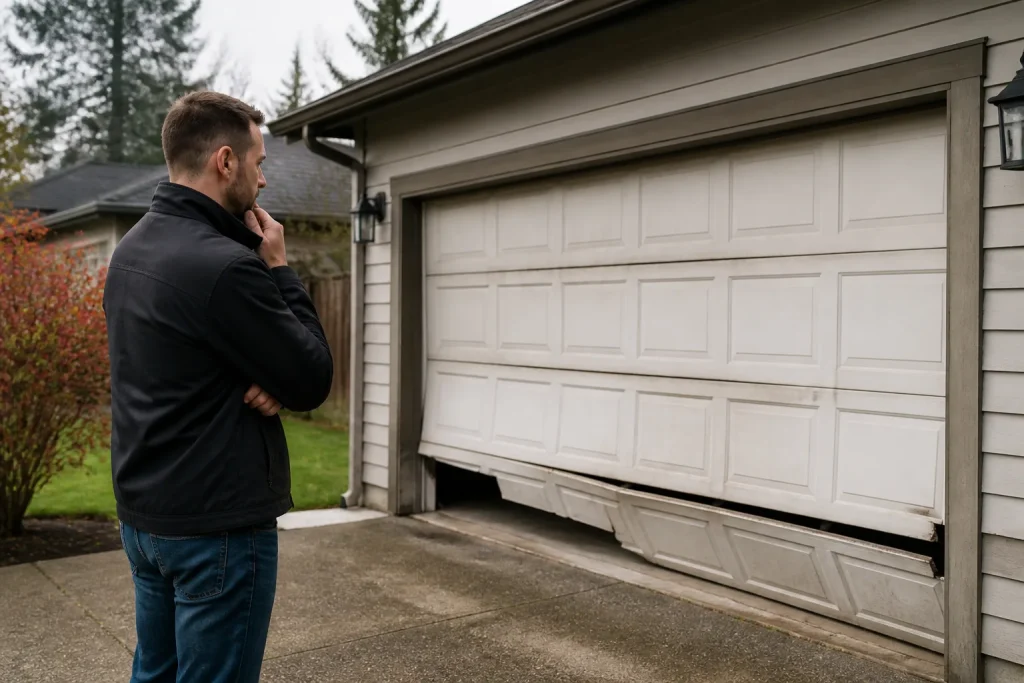
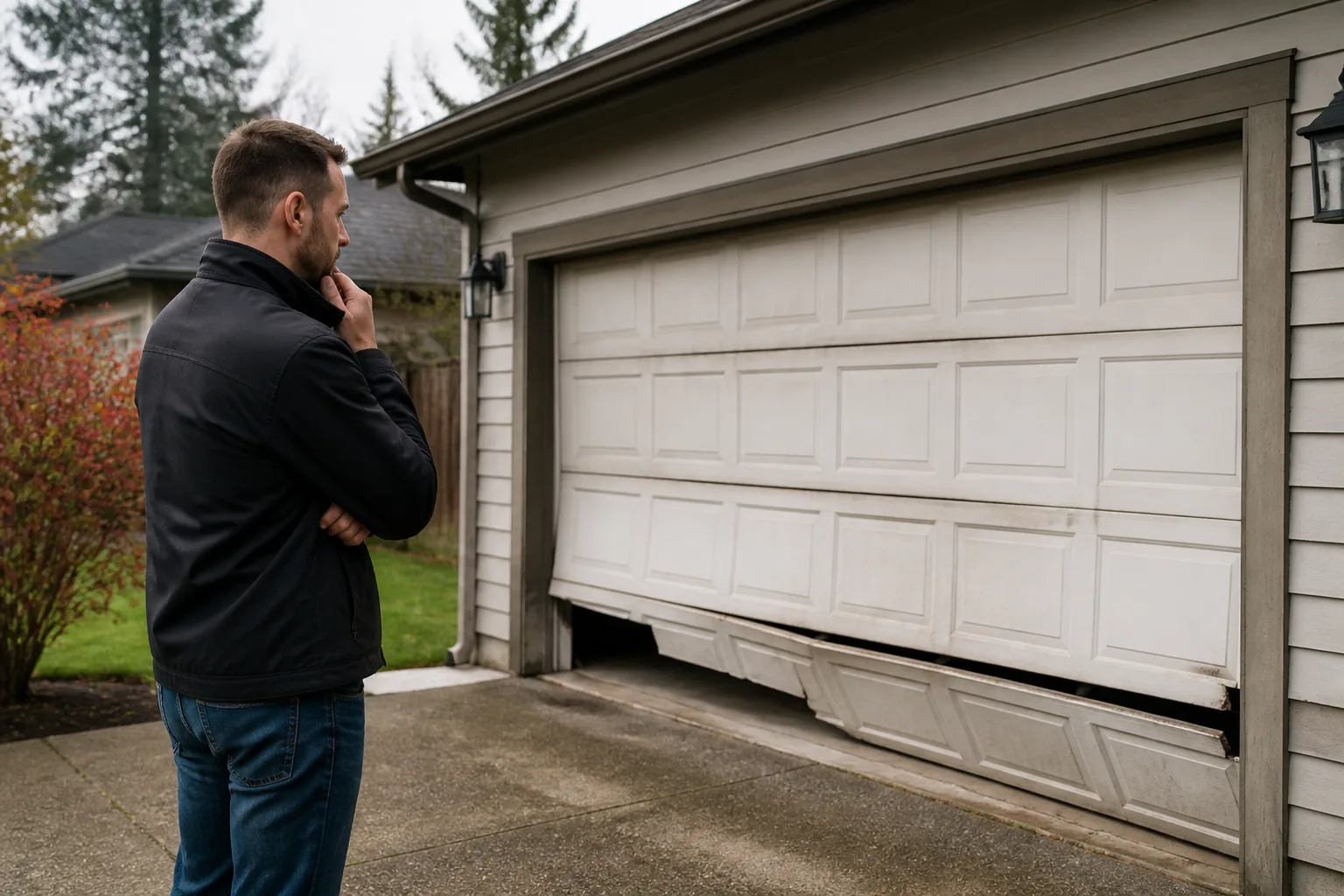
- Bottom section rusted or rotted through: assess the panel availability first, because a discontinued profile can cost more than a replacement door section should.
- Panels discontinued and only one section is damaged: the repair often stops making sense unless the rest of the door is young.
- Multiple sections damaged plus an aging opener: replacement usually wins on total cost.
- Door over roughly 15 years with repeated repairs in a single year: a strong signal that the systems are aging together.
Springs are under extreme tension and this isn’t a DIY repair. If you hear a bang from the garage and the door won’t lift, that’s a job for someone with the right tools and training. Call us for garage door spring repair.
How to assess whether the door can support another five years
Walk out to the door with the light on and look at four things. You’re not fixing anything here, you’re gathering evidence.
- The bottom section. Look for bubbling paint, soft wood, rust-through or a sagging edge. The bottom section takes the most moisture and the most impact, and once it’s compromised, the seal above it goes too.
- The weatherseal. A flattened or cracked seal lets water and cold air under the door. That’s cheap to replace and often the difference between a door that lasts and one that starts rotting from the base up.
- Track alignment. Stand back and sight along both tracks. They should be parallel and straight. Kinks, gaps at the rollers or a track that’s pulled away from the jamb mean the door is fighting itself every time it moves.
- The panels themselves. Run a hand along the seams and look for cracks, dents that have broken the finish, or panels that have started to bow. A bowing section puts uneven load on the springs and the opener.
If the bottom section is solid, the seal is replaceable, the tracks are straight and the panels are intact, the structure can usually support another five years with normal maintenance. That’s the point where repair is genuinely the smarter money.
If you’re seeing trouble in two or three of these at once, that’s a different conversation. Call garage door repair and get a proper look before you spend on a fix that won’t hold.
The panel discontinuation problem
This is the trap that catches South Hill homeowners. You get a quote to replace one dented section, you accept it, and then you find out the panel isn’t made anymore. What was a simple swap becomes a fabricated match, and the price jumps past what a full replacement would have cost.
It happens because door manufacturers retire profiles as styles change and production lines move on. A door that looked perfectly current when it was installed may have a panel style that’s been out of production for years. Nobody tells you that until you need a section.
So before you commit to a single-panel repair on an older door, ask the question directly: is this panel still manufactured? If the answer is no, or if it’s unclear, that changes the math entirely. A repair that depends on custom fabrication is rarely worth it on a door that’s already into its second decade.
When panels are still available and the rest of the door is sound, repairing makes sense. When they aren’t, replacing the door section by section isn’t a real option, and a full replacement with a current model is the more honest route. We work across the major brands, including Clopay and Raynor, so we can usually tell you quickly whether a match is realistic.
Opener replacement vs. full door replacement
Sometimes the door is fine and the opener is the problem. Sometimes it’s the other way around. Getting the order right saves real money.
Replace the opener alone when the door itself is structurally sound and the opener is the failing part: it’s noisy, it reverses for no reason, the remote has stopped pairing, or the safety sensors won’t stay aligned. A modern opener, especially a smart-home-compatible system from LiftMaster or Genie, can be a meaningful upgrade on a door that has plenty of life left. We handle garage door opener repair across the legacy Craftsman and Chamberlain ecosystem as well as newer connected units, so we diagnose by brand rather than assuming everything works the same way.
Replace the door when the structure is the problem: sagging sections, a rotted bottom section, tracks that won’t stay aligned, or panels that are discontinued. A new opener on a failing door just drives a broken door faster.
Replace both when the door is old enough that the opener’s lift capacity and the door’s weight are mismatched. That’s common on a door that’s been insulated or re-paneled over time. A new door and opener together are set up to work as a system, which is why the pair can be the better investment on a door past its second decade.
How South Hill’s climate speeds up the wear
South Hill gets real seasonal swings and real moisture. Winter rain and cold, followed by a warm, humid spring and a dry summer, works on a garage door from both sides. The bottom section is where it shows first. Water sits against the seal, the paint film breaks down, and the wood or steel underneath starts to fail from the base up.
Temperature swings stress the springs and the opener. A door that runs smoothly in July can bind in January because the metal contracts and the seals stiffen. That’s why a door that felt fine in summer can suddenly feel heavy and loud in winter. It’s not your imagination.
Steel doors with a compromised finish rust faster here than in a drier climate, and wood doors take on water along the bottom edge. The practical takeaway: inspect the bottom section and the weatherseal every year, keep the finish intact, and don’t ignore a door that’s started sticking. A one-season delay is often the difference between a cheap seal replacement and a bottom-section repair. We see it in South Hill regularly.
When to call a pro
Call a professional the moment the problem involves springs, cables or anything under tension. Garage door springs store an enormous amount of energy, and a spring that lets go while someone is working near it can cause serious injury. This isn’t a job to learn on. The same goes for a door that’s come off its track or is hanging unevenly: that’s a safety and security issue, not a weekend project.
For the routine stuff, a worn seal or a remote that won’t pair, you can absolutely handle it yourself. When it’s anything structural, we’d rather you call and let a trained technician assess it.
Related services in South Hill: if you’re weighing a full replacement, we also handle complete new-door installation, so the same team that assesses your repair can quote the replacement. One call covers repair, opener, springs or a new install.
The Bottom Line
Repair or replace comes down to whether the door’s systems can carry another few years of daily use, and that’s a physical question, not a price comparison. Use the four checks above: bottom section, weatherseal, track alignment and panel condition. Add the panel availability question and the opener compatibility question, and you’ll have a much clearer picture before anyone quotes you.
- Repair when the springs are the only failure, the seal is replaceable, the tracks are straight and the panels are still made.
- Replace when the bottom section is failing, multiple panels are damaged or the door’s model has been discontinued.
- Replace the opener alone when the door is sound and the opener is the failing part.
- Consider both when the door is past its second decade and the opener no longer matches the door’s weight.
If you’re in South Hill and need help, Garage Door Repair South Hill offers free estimates. Call (844) 443-4774. We answer 24/7, and fast dispatch from 7am to 7pm, Sunday through Friday. The written estimate sets the final price, and you’ll agree to it before any work starts.
Frequently Asked Questions
It depends on the job: a spring repair, a panel replacement and an opener repair all price differently, and the written estimate sets the final number. We quote per job after assessing the door, and you’ll see the price before we start. Call (844) 443-4774 for an exact quote, estimates are free.
It can be, if the springs are the only failure and the panels are still manufactured. It usually isn’t worth it if the bottom section has rotted or the panel style has been discontinued, because custom fabrication pushes the repair past what the section is worth. A physical assessment settles it quickly.
Check with the manufacturer or a dealer using the model and serial on the door itself. If the panel profile has been retired, a single-section repair means custom fabrication, and that’s the point where replacement usually wins. We work across Clopay, Raynor and the other major brands, so we can often tell you what’s realistic.
For emergency situations, where a broken door is open to the street or won’t secure, call (844) 443-4774 and we’ll get a technician out as soon as we can. We answer 24/7, with fast dispatch from 7am to 7pm, Sunday through Friday. Replacement and installation work is measured and scheduled, so we’ll book that into the next available slot.
Written by the team at Garage Door Repair South Hill.
Need Garage Door Help?
Call Garage Door Repair South Hill - the local pro we connect you with is licensed and insured, here with fast help in South Hill.
(844) 443-4774