
Top Signs You Need Garage Door Service – Don’t Ignore These
The clearest signs you need garage door service are a door that pauses before it moves, a cable that looks slack or frayed on one side, a spring with a visible gap, grinding or popping noises, and a door that reverses without an obvious obstruction. None of these are dramatic. That’s the problem. A garage door that hesitates for even a second before moving isn’t “just old” – it’s an opener fighting mechanical resistance, and every week you leave it, that extra load wears the motor down further. If you’d rather not crawl around with a level and a flashlight, call (844) 443-4774. We answer 24/7. Fast dispatch from 7am to 7pm, Sunday through Friday.
Why the Quiet Warning Signs Matter More Than the Loud Ones
A snapped spring announces itself. A door hanging off its track is impossible to miss. But the failures that cost the most money and create the most danger usually start as something you’d have to be looking for to notice. We’ve seen it in South Hill homes over and over: the small signal ignored for three or four months, then a full opener replacement or a bent track that could have been a simple adjustment.
The pattern makes sense once you understand how the system works. Your opener isn’t designed to lift the door. The springs do that. The opener just guides it. When a spring starts to lose tension or a roller seizes up, the opener takes on weight it was never built to carry. It still works – for a while. That “while” is measured in months, and it’s why an opener problem is often really a mechanical problem wearing a disguise.
Here’s what we tell homeowners in South Hill: trust the small changes. A door that used to glide and now pauses is telling you something. So is a noise that wasn’t there last winter. The list below covers the signals worth acting on, plus a couple of quick checks you can do yourself before you pick up the phone.
How Do You Test a Garage Door’s Balance in 30 Seconds?
You can test a garage door’s mechanical balance in about 30 seconds by disconnecting the opener and lifting the door halfway by hand. A healthy door stays put at the halfway point. A door that sinks on its own has spring tension problems. A door that’s hard to lift has rollers, hinges, or track issues. This test tells you about the door itself, completely separate from whether your opener works.
- Close the door and pull the release cord to disconnect the opener carriage. On most LiftMaster and Chamberlain openers this is the red handle hanging from the rail.
- Lift the door by hand to about waist height, then let go.
- Watch what happens. It should stay roughly where you left it.
- Reconnect the carriage by running the opener until it re-engages, or push the carriage back toward the opener head by hand.
Most homeowners in South Hill have never done this, and it’s the single most useful check in garage door maintenance. A door that drops fast at the halfway point has a spring that’s lost tension – and that door is heavier than it should be every time the opener lifts it. Reconnect carefully, and if the door won’t stay up, stop using the opener until a technician sees it.
A word on springs before you go further
Garage door springs are under extreme tension. This is not a DIY repair. The torsion spring above your door stores enough force to cause serious injury, and the tools to handle it safely aren’t in a typical homeowner’s toolbox. If the balance test points to spring trouble, that’s a job for a trained technician working on garage door spring repair.
What Does Uneven Cable Tension Look Like, and Why Is It a Safety Issue?
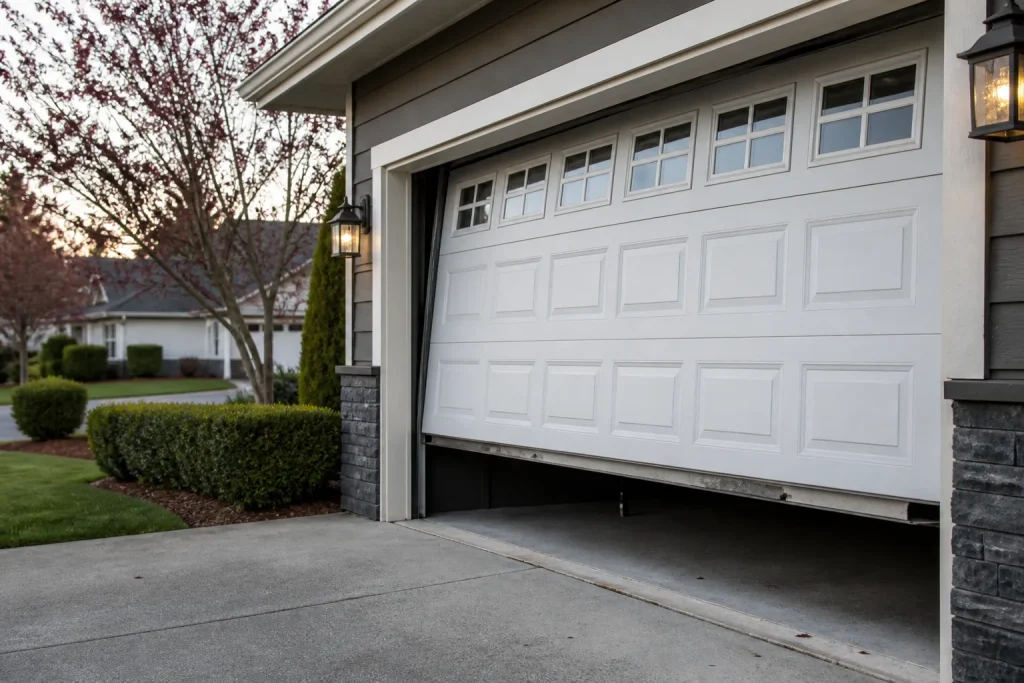
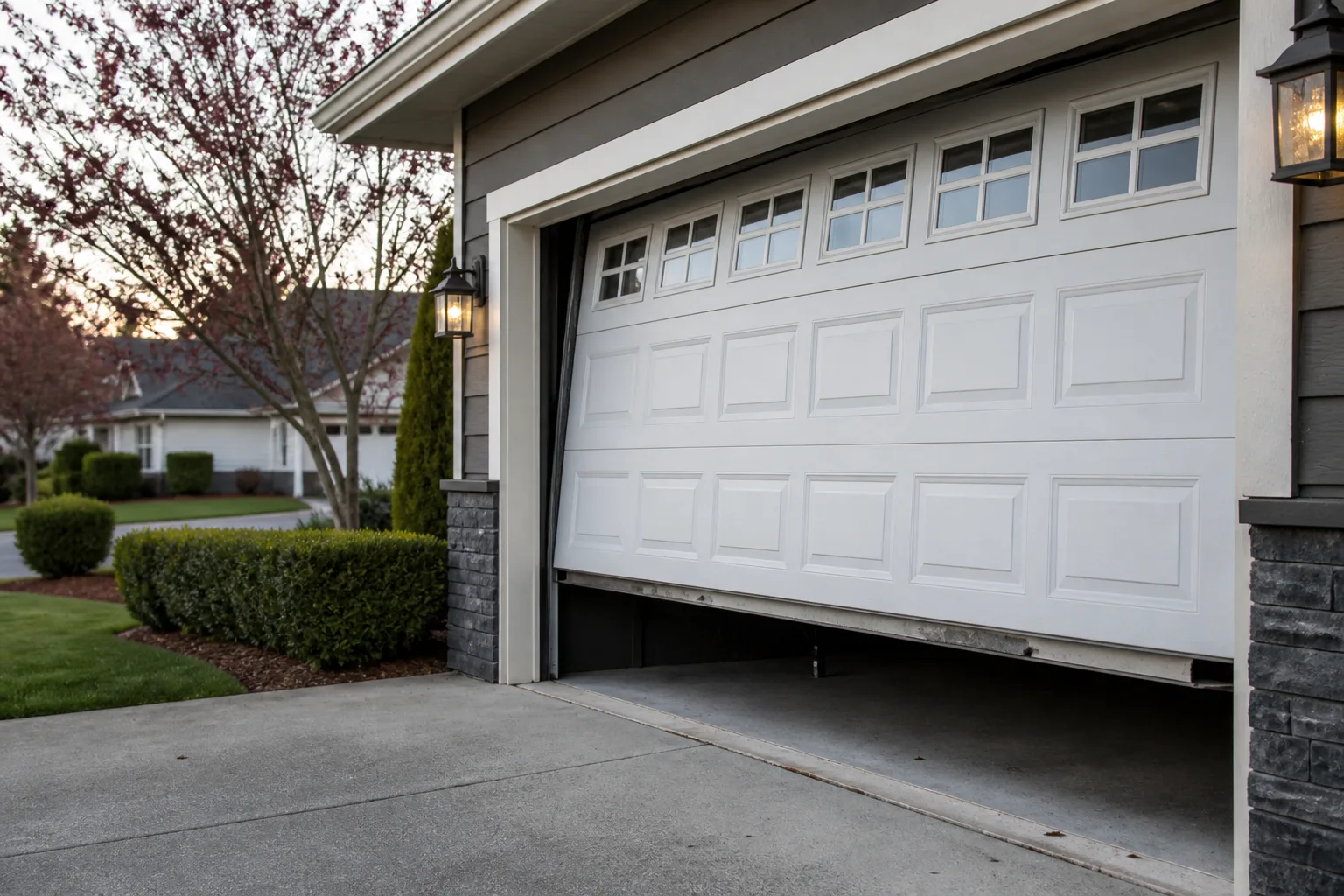
Uneven cable tension shows up as a door that’s visibly crooked – one side higher than the other – or a gap between the door and the frame on one side. From a standing position, look at the cables running down each side of the door. They should look equally taut and evenly wound on their drums. One slack, one drum with cable piled up, or a cable with visible fraying means the door is lifting unevenly and the whole system is under stress.
This isn’t only a performance problem. A cable that’s been running loose can jump its drum, and when that happens the door drops on one side without warning. That’s a genuine hazard for anyone standing under it, including kids and pets. Cables are under the same high tension as springs, and a frayed cable is a cable that’s close to failing. Don’t try to tighten or adjust one yourself.
In our experience around South Hill, cable problems often get mistaken for track problems. A door that’s suddenly binding on one side could have a bent track, but it could just as easily be a cable that’s lost tension. That’s the kind of thing you want a technician diagnosing in person, because the fix is very different depending on the actual cause.
Which Noises Mean Something Is Actually Wrong?
Normal garage door noise is a low, steady hum from the opener and a soft roll from the door. Anything sharper, louder, or new is worth investigating. The specific sounds tell you a lot about what’s wearing out:
- Grinding or scraping: usually worn rollers or a dry, dirty track. Rollers that have flattened or seized don’t roll smoothly – they drag, and the sound travels through the door.
- Popping or snapping: loose hardware, a hinge that’s worked itself free, or a spring that’s starting to fail. One pop is worth watching. Repeating pops mean stop using the door.
- Squealing: metal-on-metal contact, often a roller or hinge that’s lost its lubrication and is running dry.
- A single loud bang followed by a door that won’t lift: a spring has broken. This is the one loud signal that needs a call right away.
- Rattling from the opener itself: loose mounting bolts or a chain that needs tension. On Craftsman and Raynor systems with chain drive, this is common and usually straightforward to correct.
Modern openers from LiftMaster and Genie run noticeably quieter than older belt and chain units, so if your door got louder over a couple of seasons, that’s a mechanical change, not just your hearing. If you’re not sure whether a sound is normal, a technician can tell you in a couple of minutes.
Why Does My Door Reverse, and Why Isn’t It Always the Sensors?
A door that reverses doesn’t automatically have a sensor problem. Yes, misaligned or dirty safety sensors are a common cause – check for cobwebs, a bumped bracket, or a sun glare hitting the lens. But there are several other causes homeowners routinely miss:
- Binding in the track: if the door meets resistance, the opener reads it as an obstruction and reverses. The sensors are fine; the door itself is the problem.
- Limit switch settings: an opener whose travel limits have drifted will reverse when it thinks the door has hit something at the bottom.
- Loose chain or belt: slack in the drive system can trigger a false obstruction signal, especially on older Chamberlain and Craftsman units.
- A failing logic board: less common, but on a smart opener that’s been reliable for years, a board fault can produce erratic reversing. Diagnosing this by brand matters – we work on the brand you already have, and the diagnostic path differs between a Genie and a LiftMaster.
Before you assume sensors, disconnect the opener and run the balance test above. If the door is hard to lift by hand, you’ve found your culprit. That’s a mechanical fix, and it belongs on the garage door repair side of the house rather than the opener side.
Why Do South Hill Doors Act Up in January Through March?
South Hill’s winter moisture is hard on garage door hardware, and the problems show up in a predictable window. From January through March, we field more calls about stiff doors, sticking hinges, and openers that suddenly struggle than at any other point in the year. The cause is simple: damp, cold air works its way into hinges, rollers, and tracks, and lubrication thins out or washes away. Metal contracts slightly in the cold, which can turn a snug fit into a binding one.
You’ll notice it first as a door that’s slower to open on cold mornings, or a track that squeals when the temperature drops. Wooden door panels can also swell slightly with the moisture, which changes how they sit in the frame. If your door was fine in October and feels heavier in February, that’s the season talking, not a sudden mechanical failure.
Two habits make a real difference in South Hill. Keep the track clear of leaves and grit that blow in with the wet weather, and have the moving parts lubricated before winter sets in rather than after the door starts complaining. If your door has already started acting up this season, a routine service call is usually all it takes to get ahead of it. When something does go wrong, the smart move is the same in any month: Garage Door Repair South Hill is one call for repair, spring work, opener service, or a full new door when the old one is past saving.
When to Call a Pro Instead of Waiting It Out
Some signals you can watch for a week. Others need a call today. Call a professional if you notice any of these:
- A spring with a visible gap, or a door that won’t stay up when you test it by hand.
- A cable that’s frayed, slack, or off its drum.
- A door that reverses repeatedly, or one that’s come off its track.
- A door that’s visibly crooked, or one side that lifts before the other.
- Any loud bang from the door followed by a door that won’t open.
If your door won’t open and you’re stuck, that’s an emergency in our book, and we treat it as one. Our technicians have up to 11 years of experience across the brands most South Hill homes already have – LiftMaster, Chamberlain, Genie, Clopay, Amarr, Wayne Dalton, Craftsman, and Raynor – so we diagnose by brand, not by assumption.
Related Services in South Hill
If a warning sign points to one specific system, these pages go deeper: garage door opener repair for reversing, hesitating, or dead openers, and garage door spring repair for balance problems and broken springs.
What happens when you call
- 1
A real person answersNo phone trees – you reach a local pro.
- 2
You get an upfront price rangeHonest numbers before anyone is dispatched.
- 3
A background-checked tech heads outLicensed & insured, dispatched right away.
- 4
You approve before work beginsNothing starts until you say go.
The Bottom Line
The signs worth acting on are rarely the dramatic ones. A half-second pause, a cable that looks slightly off, a spring with a gap, a new noise that wasn’t there last season – those are the early signals that precede the expensive failures. Run the 30-second balance test, look at your cables, listen to your door, and pay attention when your South Hill door starts behaving differently in winter. Catch the small stuff and you’ll spend a lot less on the big stuff.
If you’re in South Hill and need help, Garage Door Repair South Hill offers free estimates – call (844) 443-4774. We answer 24/7. Fast dispatch from 7am to 7pm, Sunday through Friday. Every price is quoted and agreed before any work starts, and the written estimate sets the final price – no surprises when the job’s done.
Frequently Asked Questions
Most garage door repairs in South Hill fall in the range of a routine service call to a few hundred dollars depending on what’s wrong – a track adjustment or roller replacement sits at the low end, while spring replacement costs more because springs are replaced in matched pairs. Spring prices are quoted per spring, and a pair costs about twice a single spring. The written estimate you get before any work begins is the price you pay. Call (844) 443-4774 for an exact quote – estimates are free.
Yes, for repair and emergency situations we offer same-day service where dispatch allows. We answer the phone 24/7, and fast dispatch runs from 7am to 7pm, Sunday through Friday. A call outside dispatch hours is booked into the next opening. Installation and full replacement work is measured, ordered, and scheduled rather than same-day. Call (844) 443-4774 to check availability.
No. The price is quoted and agreed before any work starts, and the written estimate sets the final price. If we find something unexpected during the job, we tell you before we do anything about it, so you’re never handed an invoice bigger than the number you agreed to. Call (844) 443-4774 to book a free estimate.
The local professionals we connect you with are licensed and insured as their state requires. Our technicians have up to 11 years of experience, and we work across the major brands most homes already have. If you’d like details before booking, call (844) 443-4774 – we’re happy to walk you through it.
Written by the team at Garage Door Repair South Hill.
Need Garage Door Help?
Call Garage Door Repair South Hill - the local pro we connect you with is licensed and insured, here with fast help in South Hill.
(844) 443-4774